
Course DetailsHome / Courses Details
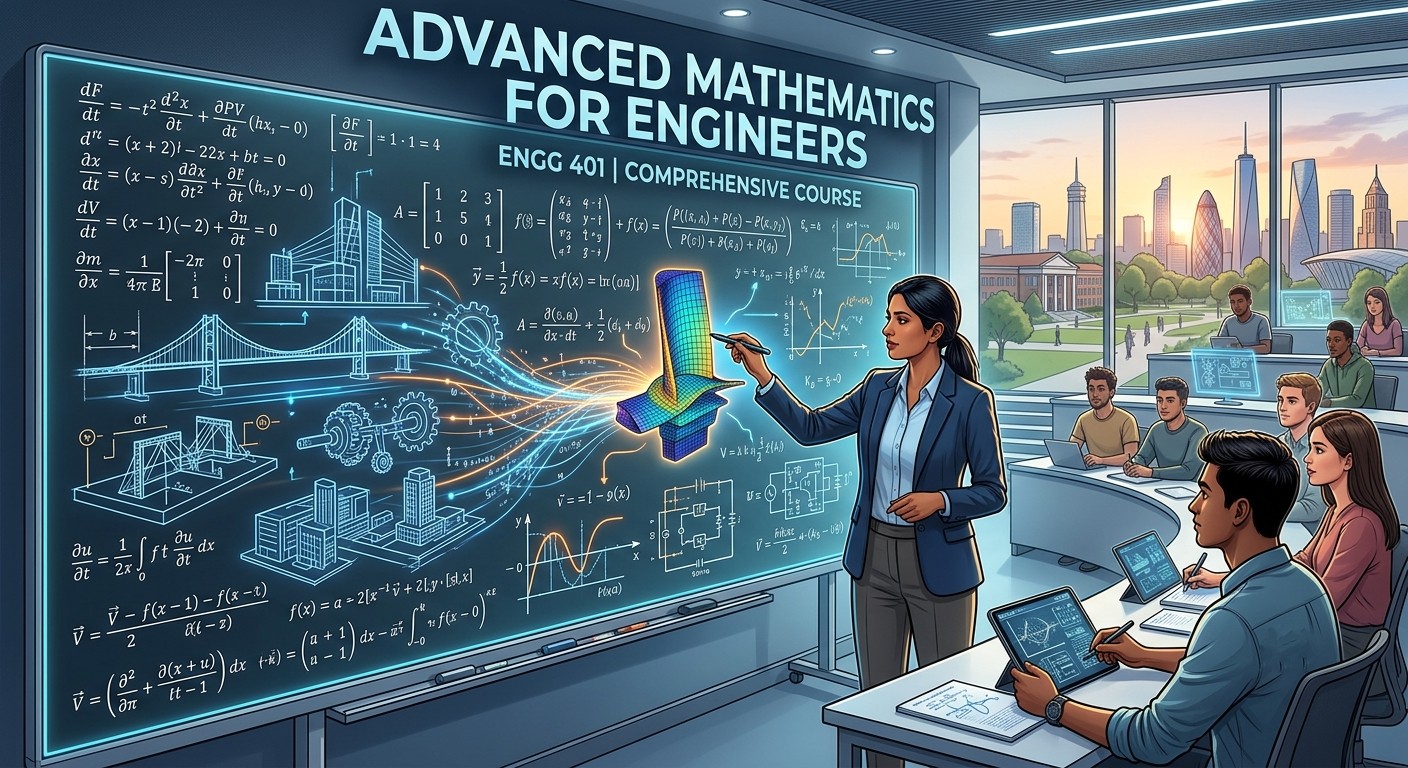
Advanced Mathematics for Engineers
Course Overview: Advanced Mathematics for Engineering
This rigorous course is designed for engineering students seeking to master the advanced mathematical concepts essential for professional practice and further academic study.
Course Objectives
- ✔ Apply mathematical principles to solve complex, real-world engineering problems.
- ✔ Develop robust analytical and critical thinking skills.
- ✔ Establish a strong mathematical foundation required for advanced engineering research and design.
Course Curriculum Roadmap
This program is structured across eight progressive modules, transitioning from foundational multivariable concepts to applied research and simulation techniques.
Phase I: Analytical Foundations
- Module 1: Multivariable Calculus & Vector Analysis
- Module 2: Linear Algebra & Matrix Theory
- Module 3: Ordinary & Partial Differential Equations
Phase II: Advanced Analytical Tools
- Module 4: Probability & Statistical Analysis
- Module 5: Numerical Methods & Computational Mathematics
- Module 6: Complex Analysis & Transform Methods
Phase III: Integration & Innovation
- Module 7: Mathematical Modeling & Simulation
- Module 8: Advanced Topics & Research Applications
Prerequisites & Student Profile
To succeed in this rigorous course, students are expected to meet the following criteria:
Academic Foundation
- Strong mastery of Algebra and Geometry.
- Competency in basic Calculus.
- Satisfactory completion of all introductory mathematics prerequisites.
Skills & Mindset
- Recommended: Proficiency with graphing calculators/math software.
- Essential: Capacity for abstract reasoning.
- Essential: Passion for complex, multi-step problem-solving.
Course Learning Resources
- Textbooks & Reference: Comprehensive materials for in-depth theoretical study.
- Interactive Software: Access to cutting-edge mathematical modeling tools.
- Problem Sets: Curated practice exercises with detailed solution guides.
- Multimedia: High-quality online video lectures and tutorials.
- Collaboration: Facilitated study groups and peer-learning opportunities.
- Lab Access: Dedicated computer labs equipped with specialized software.
- Advanced Topics: Supplementary readings to challenge and expand your knowledge.
38
Students
32
Lessons
72
Hours
Advanced
Level
4.6
Rating (98)
.png)
Edu Suite simplifies school tasks, allowing teachers to efficiently manage attendance and grades. By streamlining their work, teachers can focus more on helping students succeed.